
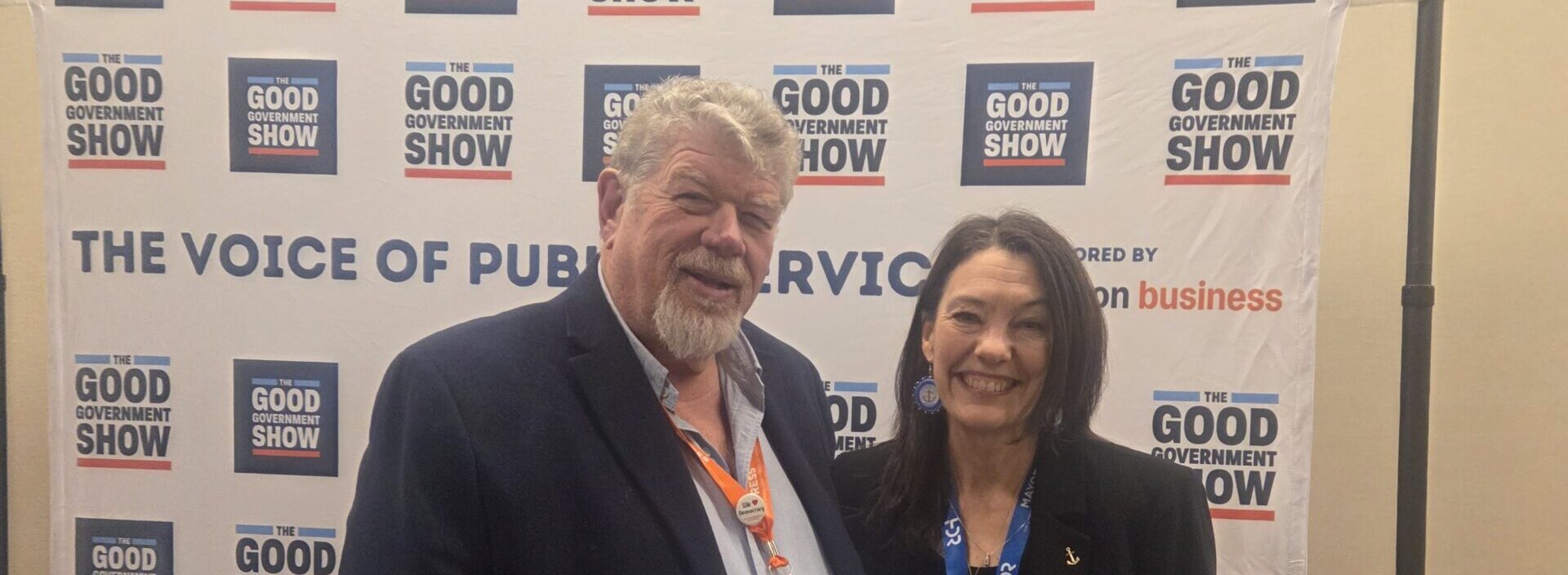
Mayor Suzanne LaFrance joined the conversation. Our first guest from Alaska so naturally we started talking about snow. But Anchorage is a true American city with some of the same challenges other mayors face. Give a listen.
Talking Snow in Anchorage, Alaska
This episode brought to you through the generosity of our supporters
00:00:00:04 – 00:00:03:14
David Martin
This is the good government show.
00:00:03:19 – 00:00:09:45
Suzanne LaFrance
We don’t have a whole lot of roads, so we’ve got a lot of pilots.
00:00:09:49 – 00:00:21:22
Suzanne LaFrance
We’ve got Taylor Drift out there, we’ve got Blizzard Wizard, Lady Gaga, Darth Greater, Rex, the big Sky.
00:00:21:27 – 00:00:28:10
Suzanne LaFrance
Primarily we fund our government with property taxes.
00:00:28:15 – 00:00:35:53
Suzanne LaFrance
So we built 32 micro homes as part of a recovery residence.
00:00:35:57 – 00:00:52:35
David Martin
Anchorage, Alaska is the biggest city in the state, and on this episode, I talked to the mayor about her city and what makes it different and the same as every American city. Wait till you hear about The Big Lebowski. That’s today on The Good Government Show. As always, like us and share us on your favorite social media and leave a comment.
00:00:52:37 – 00:01:15:38
David Martin
Go to our website. Good government show for extras. Mayor Suzanne LaFrance joins the show, sees our first Alaska guests. So let’s start with a few Anchorage fun facts, especially if you’re like me and don’t know much about the city. It’s actually the third largest city by area in America, and it does have four seasons and Anchorage. You can have up to 22 hours of light in the summer, although you can have just five hours in the winter.
00:01:15:43 – 00:01:34:27
David Martin
Anchorage residents often top the list of ice cream consumption per capita. That’s a lot of ice cream in the winter. The city is on the coast and it’s surrounded by lakes and glaciers. Back to government. Anchorage, like any city, has a homeless problem. And the mayor and I talk about solutions. I should add, we talked earlier this year the conference of mayors gathering in Washington.
00:01:34:27 – 00:01:58:55
David Martin
Since then, the mayor has made progress on the issue and other Anchorage news. The city was finally able to close a deal to get more federal dollars to help improve the city’s port terminal. Marilla France has also recently announced a quantity of life task force and coordination with the governor’s office. The task force is targeting local crime, so coming up a trip north to Alaska with the mayor of Anchorage, Suzanne LaFrance.
00:01:59:00 – 00:02:29:03
David Martin
Hello nation is our partner here at the Good Government Show. This is a new direction from CGI digital. Hello nation is CGI new online digital magazine that showcases the best of cities across the nation. We’d all prefer of. Good news traveled faster at Hello Nation. Positive stories don’t just get told, they get amplified. Hello nation helps businesses, leaders, and communities share positive stories that matter building trust, credibility and meaningful connection through professionally produced podcasts, digital features, and targeted distribution.
00:02:29:03 – 00:02:52:25
David Martin
Hello nation positions you as the answer regular folks are looking for, while expanding and scaling your digital footprint across the platforms that people trust. Good news deserves momentum. Your city or your business can help spread the word of good news across the nation. At Hello Nation, they don’t have advertisers. They have advisors, editorial content from trusted community leaders and cities that are spreading the good news.
00:02:52:25 – 00:02:59:18
David Martin
Let Hello Nation lift you up and lead the conversation. That’s Hello Nation.
00:02:59:22 – 00:03:17:40
David Martin
Once you wrap up this episode of The Good Government Show, give a listen to our friends over at Good News for lefties. This daily podcast highlights news stories that show there’s more good news out there. Other people in government are really trying to do the right thing. That’s good news for lefties. Listen where you’re listening now.
00:03:17:45 – 00:03:29:59
David Martin
Welcome to The Good Government Show. I’m happy to have with me Suzanne LaFrance. She is the mayor of Anchorage, Alaska. Welcome to the show. And you are our first Alaska mayor or first Alaska politician government leader to join us. Thank you.
00:03:30:01 – 00:03:31:54
Suzanne LaFrance
It’s great to be here. Thanks for having me.
00:03:31:56 – 00:03:37:25
David Martin
We are here in Washington. It is January. How’s the weather here compared to the weather in Alaska right now?
00:03:37:27 – 00:03:39:25
Suzanne LaFrance
You know, it’s actually a little bit colder here.
00:03:39:27 – 00:03:40:12
David Martin
Is it really?
00:03:40:13 – 00:03:40:51
Suzanne LaFrance
It is.
00:03:40:53 – 00:03:58:43
David Martin
All right, so that’s why you’re walking around in a bathing suit. No no, no, just just kidding. So I don’t know where to begin. Anchorage, Alaska. Is it a typical American city? Is it different than every American city? Is it completely different? Is it a completely unique environment, or is it just another city like every other city in America?
00:03:58:45 – 00:04:00:27
David Martin
The same problem, same challenges?
00:04:00:28 – 00:04:11:18
Suzanne LaFrance
Well, we’re unique in our own ways. And, you know, being in Alaska, for one thing, sets us farther apart from the contiguous United States, which we finally refer to as the lower 48.
00:04:11:20 – 00:04:13:23
David Martin
Yes, to the lower 48. Thank you.
00:04:13:25 – 00:04:17:42
Suzanne LaFrance
But I think every place has things that make them special and unique.
00:04:17:44 – 00:04:19:27
David Martin
What makes you Anchorage special and unique?
00:04:19:30 – 00:04:43:52
Suzanne LaFrance
Well, you know, we are isolated from the rest of the states and folks do a lot of travel. We love getting outdoors, okay. We don’t have a whole lot of roads, so we’ve got a lot of pilots up there, and people use their all terrain vehicles and lots of hiking. It is a little bit dark in the winter and summer hits, and it’s really there’s a lot of daylight and people get amped up.
00:04:43:52 – 00:04:54:01
Suzanne LaFrance
But, you know, we have such a strong sense of community and it feels like all of Alaska is really just one big town. And so I love that part of the culture.
00:04:54:03 – 00:04:57:25
David Martin
Anchorage is the biggest city in Alaska. Yes, yes. And the population is.
00:04:57:39 – 00:04:59:06
Suzanne LaFrance
About 280,000.
00:04:59:08 – 00:05:01:15
David Martin
Okay. That’s a that’s a substantial city.
00:05:01:17 – 00:05:12:05
Suzanne LaFrance
Well, and we’re a combined city borough. Okay. So we’re really a municipality. And so we have several distinct communities within that area, which is about the size of Delaware.
00:05:12:07 – 00:05:20:23
David Martin
Okay. All right. So it’s not it’s not that small. Now, we talked before we turn the microphones on, and you told me that you have decided to name your snowplows.
00:05:20:26 – 00:05:20:58
Suzanne LaFrance
Oh, yeah.
00:05:20:59 – 00:05:25:30
David Martin
Tell me about this, because this is this is fun. This is awesome. I want to hear all about this.
00:05:25:33 – 00:05:47:17
Suzanne LaFrance
Yeah. This has been hugely popular. You know, when I came in, we had some work to do to improve our snow removal process. And so we had a snow solutions team and they tackled some of the operations issues. We acquired new equipment, and we also procured some GPS devices and put them on the plows and had a naming contest.
00:05:47:22 – 00:05:49:00
David Martin
How many snow plows do you have?
00:05:49:03 – 00:05:58:36
Suzanne LaFrance
Oh gosh. Sometimes it never seems like enough. And we’re going to be getting some more newer equipment. But the names that people came up with were really great.
00:05:58:36 – 00:05:59:57
David Martin
And let’s let’s hear them.
00:06:00:00 – 00:06:18:08
Suzanne LaFrance
Yeah. Kids and adults alike participated. So we’ve got Taylor Drift out there. Taylor drift, Blizzard wizard, Lady Gaga, Darth Vader. All right, Rex the big sky. And that’s just a few of them. I think there’s a snowy mix. Snow face or plow? Plow face.
00:06:18:10 – 00:06:22:34
David Martin
Okay. Out there? How many how many snow plows have names? All of them?
00:06:22:39 – 00:06:37:48
Suzanne LaFrance
Yes. And will be naming the new ones as they come in. And then there’s also been some public requests to name all of our equipment, including the smaller pieces that remove snow from sidewalks.
00:06:37:48 – 00:06:40:33
David Martin
And why not? Why not?
00:06:40:38 – 00:06:45:21
Suzanne LaFrance
You know, and people love how they can go online and track where Lady Gaga is.
00:06:45:23 – 00:06:48:40
David Martin
All right. Well, I’m going to have to check this out, so you just go on. Anybody can do it, right?
00:06:48:42 – 00:06:51:04
Suzanne LaFrance
Yep. Uniform on snow plow.
00:06:51:06 – 00:06:59:06
David Martin
So if anybody’s interested in the weather in Anchorage, Alaska, you can go in. You can. And you can follow your favorite snow plow. That’s right. What was the one? The Big Lebowski thing?
00:06:59:08 – 00:07:00:31
Suzanne LaFrance
Yes, the big.
00:07:00:36 – 00:07:05:53
David Martin
Sky, the Big Lebowski, that’s the. That’s the what I’ll follow. So this is a this is a successful program.
00:07:05:56 – 00:07:32:16
Suzanne LaFrance
Yes. The naming the snowplows. Right. It is. Yeah. And but even more important, the snow removal efforts have really been improved over the last couple of years. We’ve added more operators. We have coordinated our teams in a way that is more efficient. We’ve added new equipment. We coordinate closely with the school district, and we’re right near a military installation as well.
00:07:32:16 – 00:07:40:27
Suzanne LaFrance
And our coordination with the state of Alaska is key, because a lot of the roads in our community are owned by the state.
00:07:40:29 – 00:07:50:19
David Martin
I’m going to expose my my Anchorage ignorance. Does it snow all winter long? Is there snow on the ground from, you know, December through April?
00:07:50:24 – 00:07:56:07
Suzanne LaFrance
For the most part, I mean, that first snow might be in September. May not stick around.
00:07:56:09 – 00:07:56:29
David Martin
I thought.
00:07:56:31 – 00:07:58:26
Suzanne LaFrance
Okay, but a lot of times, you know, if.
00:07:58:38 – 00:08:00:16
David Martin
So, these plows are active.
00:08:00:19 – 00:08:00:45
Suzanne LaFrance
Yes.
00:08:00:47 – 00:08:02:38
David Martin
For six or more months out of the year.
00:08:02:40 – 00:08:03:26
Suzanne LaFrance
Oh, yes.
00:08:03:28 – 00:08:10:18
David Martin
Is it difficult to maintain your fleet? And is that a problem for you as mayor to to keep the fleet running and operational?
00:08:10:20 – 00:08:33:45
Suzanne LaFrance
Well, we’ve definitely budgeted for a contingency. And, you know, one of the issues that we had coming in was that with an aging fleet, certain parts would fail and you could kind of predict it. And so one of the things that we’ve done is made sure that we have those parts on hand. Okay. And again, you know, we’ve had to we’ve had to budget for it.
00:08:33:45 – 00:08:35:57
Suzanne LaFrance
But this is a huge priority for our community.
00:08:36:00 – 00:08:43:33
David Martin
It must be because it’s Anchorage, Alaska where there’s always snow. Have you learned more about snow plows and snow equipment in the last year than you ever thought you’d know?
00:08:43:35 – 00:08:44:14
Suzanne LaFrance
I’ve definitely.
00:08:44:14 – 00:09:05:04
David Martin
Learned more. So I did a little bit of checking, and I wanted to ask you about a couple of things that seem to be happening in your city. The first is, and I did not. I just didn’t think about this. You have a homeless problem. And that has to be a huge challenge, because I would imagine that it’s really hard to be homeless overnight in Anchorage, Alaska in the winter.
00:09:05:05 – 00:09:06:55
David Martin
It is. So what do you do about this?
00:09:06:58 – 00:09:29:11
Suzanne LaFrance
Well, coming in as an administration, my team and I were very clear about what we needed to do. And first and foremost, we need to make sure that everyone has a place to go, that we have fewer people sleeping outside. It was important to set up year round shelter, because what we saw was that people, you know, we’d stand up emergency shelter when it got cold.
00:09:29:11 – 00:09:52:00
Suzanne LaFrance
And then in the spring, people were close and folks were back out on the streets. And so now we have it year round. We’ve focused on connecting people to crisis care as well, and housing and treatment, and really develop some partnerships with nonprofits and other agencies that can help us provide options to people.
00:09:52:07 – 00:09:56:12
David Martin
And that’s I’ve heard this from other mayors, is that those partnerships are vital.
00:09:56:19 – 00:10:31:48
Suzanne LaFrance
Absolutely key. And, you know, like so many other communities, and this is a nationwide issue, we are certainly not alone in addressing homelessness. And we saw during Covid that are numbers of unsheltered homeless individuals went up like 300% and never came down. And so we’ve been very focused on, you know, we came in and we abated some long standing encampments that had like 150 people and that were places that were unsafe for the people living there and the people living nearby, and.
00:10:31:50 – 00:10:35:12
David Martin
They had camps set up for outside. There were living in.
00:10:35:14 – 00:10:37:57
Suzanne LaFrance
Oh. Oh, yes. Very big camps with.
00:10:37:57 – 00:10:39:40
David Martin
Structures at night in the winter.
00:10:39:52 – 00:11:00:49
Suzanne LaFrance
Yes. I mean, some people had some pretty significant structures. You know, when I toured one, there was a gentleman who was digging out a basement for what he he had a vision that was right before that was right before we abated. But it was very it was very entrenched as far as an encampment went, this particular one.
00:11:00:51 – 00:11:06:57
David Martin
Did you get pushed back when you tried to shut these camps down, or was everyone actually excited that there was they were going to move on?
00:11:06:58 – 00:11:42:26
Suzanne LaFrance
Well, the community, the nearby community had been dealing with some hardships associated with the camp. I mean, there was drug trafficking violence, right? Suspected human trafficking as well. And so they were very happy to see us take action on that camp. You know, in other folks in our community just wanted to make sure that individuals, you know, in behavioral health crisis or substance misuse crisis or whatever their circumstances, you know, had access to help and support and options.
00:11:42:27 – 00:11:47:29
David Martin
So these these new shelters that you’ve started, do you have all those wraparound services available for everyone?
00:11:47:31 – 00:12:15:47
Suzanne LaFrance
We partner with organizations to make sure that people get into the system and can get the support they need. We operate one shelter, and there are other partners in the community that also operate shelters. And, you know, with varying levels of entry and high and low barrier. So we’re we’re working together to ensure that we have the options that the people who are living outside, you know, really need and want.
00:12:15:49 – 00:12:22:05
David Martin
And are there people and what do you do with these people who say, no, I’m not I’m not going to the shelter. I’m staying here.
00:12:22:08 – 00:12:50:01
Suzanne LaFrance
Yeah. You know, that’s definitely an issue. And we’ve also focused on outreach. And like before we abated the very large camp, we did months of outreach and in some cases, trying to really build trust with folks who, you know, experiencing trauma to try to get them to come in. We did see that when we had a cold snap and it was, you know, single digits below zero for like a month or so in December.
00:12:50:01 – 00:12:51:06
David Martin
Okay, that’s a cold snap.
00:12:51:08 – 00:13:21:09
Suzanne LaFrance
That’s. Yeah, it was it was prolonged. Then we did see some folks who’d been living outside for years come in. But we’ve also done some things to promote the number of engagements with our frontline folks. And, you know, whether that’s our outreach workers, our police officers, you know, we’ve we’ve tightened up the rules around camping and in public places and on trails and in parks, and mostly folks comply.
00:13:21:09 – 00:13:40:39
Suzanne LaFrance
But we see that there are others who, after a certain number of touchpoints, will say, yeah, what have you got from me? You know, I want to I want treatment or shelter or housing. And that’s a big part of how we’re making progress to address those folks who initially say, no, I don’t, I don’t want I don’t want any of those things.
00:13:40:41 – 00:13:55:00
David Martin
Well, that is good government. I read a little something about you. There’s a citywide program to make city spaces safer. So I guess this is all tied in together. Can you explain what this program is? Because it sounds like that the idea is a safer Anchorage.
00:13:55:02 – 00:14:30:00
Suzanne LaFrance
Yes. Our public spaces need to be safe and accessible for everyone. And one thing that makes Anchorage, I think, unique is we have a tremendous trail system in our community, and we have some really wonderful parks, and some of those are, as we say, in the bowl, some are up high in the Chugach, but those have been places where people camp and where other people oftentimes don’t feel safe because there are folks who are engaging in dangerous or inappropriate behavior.
00:14:30:02 – 00:14:54:18
Suzanne LaFrance
And in addition to making changes around camping in public spaces, we also have made propose some changes. Its before our assembly for action and hopefully they’ll approve it on Tuesday that address inappropriate and unsafe behaviors. You know, behaviors that are never appropriate in public.
00:14:54:20 – 00:14:55:35
David Martin
Are you making Anchorage safer?
00:14:55:37 – 00:14:56:20
Suzanne LaFrance
Yes we are.
00:14:56:25 – 00:15:10:50
David Martin
All right, well, you’re the mayor. Good. Now, I also read one other thing I wanted to ask you about is you are trying to sell. I think it’s a $12 million tax for the the city schools. How do you sell a tax?
00:15:10:55 – 00:15:12:10
Suzanne LaFrance
Yeah. Well.
00:15:12:12 – 00:15:13:55
David Martin
She said after a long, deep breath.
00:15:14:02 – 00:15:36:15
Suzanne LaFrance
Long, deep breath. Yeah. You know, and this is an issue I know, not just in our community, but Alaska is unique. We we don’t have an income tax. We don’t have a state sales tax. Some communities have sales taxes. We do not have one in Anchorage. I mean, we have an alcohol tax and a cannabis tax and a motor fuel tax.
00:15:36:15 – 00:16:08:28
Suzanne LaFrance
That’s not a retail tax. Primarily we fund our government with property taxes, okay. The state of Alaska is responsible for providing a quality education to students. However, local communities have a responsibility to pay or are required to pay a local contribution. It’s called and through some changes in the amount that the state provides. We realize that in addition to well, we always pay our required contribution.
00:16:08:28 – 00:16:35:12
Suzanne LaFrance
And then there is an optional one that you can tax yourselves for. And normally we do that. We don’t do it separately, but because of changes in the formula we realize that, oh, we can actually give more this year to the school. And so we thought that we would put that before the voters for them to consider. I mean.
00:16:35:26 – 00:16:39:02
David Martin
Are the voters reacting so far? Are they? Are they on board with this, with the tax?
00:16:39:04 – 00:16:43:02
Suzanne LaFrance
People do support our public schools and recognize how.
00:16:43:07 – 00:16:44:42
David Martin
Is it a hard sell? Is it a hard sell?
00:16:44:45 – 00:17:13:54
Suzanne LaFrance
Well, we’ll find out in April. You know, the conversations are just starting. Okay. And, you know, some people have concerns because we do not have a diversified revenue base. And so bonds and general government, this is all funded through our property taxes. But for the most part, you know, there’s there’s a lot of support. We really need to have some stable funding from our state government, the state of Alaska, and it limits the amount local communities can contribute towards schools.
00:17:13:55 – 00:17:19:19
Suzanne LaFrance
And that’s done so that there’s equity, you know, among. It sounds.
00:17:19:19 – 00:17:25:59
David Martin
Like it sounds like there’s not a lot but a fair amount that’s sort of out of your hands in your city as mayor.
00:17:26:02 – 00:17:46:46
Suzanne LaFrance
Yes. When it comes to education. Definitely. This was something we saw that we could do again. You know, the numbers had changed and it opened up this space for okay, we can ask our community, you know, do you want to tax ourselves for this additional 12 million that will keep more teachers in the school district and lower classroom sizes?
00:17:46:49 – 00:18:04:50
David Martin
Well, I think people are in favor of that. Yeah. So we’re here at the Conference of Mayors in Washington, where it’s colder than it is in Anchorage right now in January. You were just at a program called Bloomberg Cities Ideas Exchange. What I was were exchanged. What were you talking about? Because you were one of the what? You were one of the panelists.
00:18:04:59 – 00:18:47:54
Suzanne LaFrance
My team got to participate in this program through Bloomberg to build 32 micro homes. And this was based on a project, a successful project in Atlanta. And so we had a couple team members who went to Atlanta and learned more about how did they make this work. We started off looking at shipping containers as part of potential shelter, transitional housing for folks experiencing homelessness, and found that actually, it made more sense for us to construct units because we would have had to retrofit the shipping containers due to the cold in Anchorage.
00:18:47:57 – 00:18:48:49
Suzanne LaFrance
Sure. Yeah.
00:18:48:52 – 00:18:49:45
David Martin
So what did you build?
00:18:49:47 – 00:18:57:20
Suzanne LaFrance
So we built 32 micro homes as part of a recovery residence, and we did this.
00:18:57:22 – 00:18:58:42
David Martin
On fully insulated, I’m guessing.
00:18:58:44 – 00:19:30:37
Suzanne LaFrance
Fully insulated. Each one has its own individual electric heater. They are not plumbed. So there is a shared bathroom shower space and also a shared another separate building, a communal space. And the intent is that it’s for folks coming off the streets who want to engage in treatment. And so they will have their own space where with their own door that can be closed and locked while they go through treatment program.
00:19:30:40 – 00:19:35:59
David Martin
I’ve seen some of those container houses. Pretty impressive actually. Yeah, yeah, yeah.
00:19:35:59 – 00:19:55:02
Suzanne LaFrance
And these are, you know, the 32 units are on about a quarter of an acre, and they’re pretty close together. Okay. There was another there was a church that did a pilot project in our backyard. They called it. And so we’ve been working with them and, you know, lessons learned. And between them and then the support through Bloomberg, Bloomberg is amazing.
00:19:55:05 – 00:20:00:33
Suzanne LaFrance
They do some incredible things and provide communities with so many resources.
00:20:00:35 – 00:20:06:11
David Martin
Were there any other discussions other than the micro homes? Just curious if there are any great ideas that were exchanged.
00:20:06:14 – 00:20:12:08
Suzanne LaFrance
You know, that’s something that boy, there are always great ideas from other communities.
00:20:12:08 – 00:20:21:46
David Martin
Well, that’s what I’ve heard from mayors is the best idea is probably another mayor’s already done. And you know, you don’t have to reinvent the wheel. You just call your friend and say, how did you make homes?
00:20:21:49 – 00:20:41:35
Suzanne LaFrance
Oh, absolutely. And this is a pilot project for us. And so we are aware of some of the challenges going in around sustained funding. We have a third party operator who will be on site, you know, to provide the behavioral health support and know that, you know, that’s a challenge other communities have face. It always is the ongoing operational funding.
00:20:41:35 – 00:20:50:01
Suzanne LaFrance
But, you know, this, again, is a pilot project. And we got to learn from others and it’s iterative. And we’ll share what we’ve learned with others too.
00:20:50:04 – 00:20:53:18
David Martin
So call the mayor of Anchorage and you’ll tell them how you did it now.
00:20:53:20 – 00:20:53:37
Suzanne LaFrance
Sure.
00:20:53:37 – 00:21:01:46
David Martin
Why not? Before I get into our questionnaire, I have to say giant anchor earrings and a giant anchor pin on your jacket. Is this your standard? Where?
00:21:01:49 – 00:21:02:53
Suzanne LaFrance
On a lot of days.
00:21:02:56 – 00:21:07:41
David Martin
Yes. All right, so Anchorage, the anchor of Anchorage. Right?
00:21:07:43 – 00:21:08:46
Suzanne LaFrance
The anchor of Anchorage.
00:21:08:48 – 00:21:15:41
David Martin
That’s right. All right. We’re going to come back. We’re going to ask you a lot of questions.
00:21:15:45 – 00:21:39:34
David Martin
The Good Government Show is sponsored by our that’s our for our community. Get involved. We hear that all the time from government leaders. Our co brands with your government’s name and logo. Your staff and the people you serve are connected and part of your community. From any device. Your members provide reliable data and meaningful feedback. Ask a question like do we want more parkland or better homeless services?
00:21:39:34 – 00:21:51:00
David Martin
More engaged conversations come through the our app. Visit our code that’s Cocom and book a demonstration.
00:21:51:05 – 00:22:16:42
David Martin
After you get done with this episode. Hear more good government stories with our friends at How to Really Run a City for members Kasim Reed of Atlanta and Michael Nutter of Philadelphia, and their co-host, journalist and author Larry Platt talk with guests and other mayors about how to really get stuff done in cities around the nation. Check them out where you’re listening now or through their nonprofit news site, The Citizen Dawg.
00:22:16:46 – 00:22:20:56
David Martin
It’s.
00:22:21:01 – 00:22:46:18
Narrator
Across America. There is a growing demand for leadership that delivers results over rhetoric. The Good Government Institute brings together proven ideas, principled leaders, and real world solutions to strengthen how we govern not by reinventing the system, but by advancing what already works. On our flagship podcast, The Good Government Show, we highlight the leaders behind that progress, demonstrating how effective governance begins with listening, respect and a commitment to serve.
00:22:46:21 – 00:22:52:23
Narrator
Visit Good Governance Institute to learn more.
00:22:52:28 – 00:23:00:27
David Martin
So we have a good government show questionnaire, and I want to just get into this, and this will get into your personal philosophy about government. What is good government?
00:23:00:27 – 00:23:05:00
Suzanne LaFrance
Defining good government is providing the services that people need.
00:23:05:05 – 00:23:06:22
David Martin
That’s it. That’s all.
00:23:06:24 – 00:23:15:31
Suzanne LaFrance
Well, I mean, it has to do with transparency and good communication and ensuring that what we do provides public value.
00:23:15:33 – 00:23:17:45
David Martin
What drew you to public service? What made you get into this?
00:23:17:48 – 00:23:28:18
Suzanne LaFrance
I ran for our Anchorage assembly and ended up being in that seat for six years, and during that time I grew to absolutely love local government. It’s where the rubber meets the road.
00:23:28:21 – 00:23:35:59
David Martin
I’m getting the high sign that you have to go. I want to ask you just two more questions. I’ve never been Anchorage. I’m coming to your city. Where are we going? What’s the dish of Anchorage?
00:23:36:01 – 00:23:53:36
Suzanne LaFrance
Oh, boy, there’s so much to do. So when you come in. Well, you got to come by City Hall. Yes. And say hello. Okay. But, I mean, I think our trail system is fabulous. And we have a wonderful museum. And the Alaska Native Heritage Center offers some really great opportunities as well.
00:23:53:45 – 00:23:55:19
David Martin
Is there a cuisine of Anchorage?
00:23:55:21 – 00:23:58:36
Suzanne LaFrance
Oh, we’ve got a whole bunch of different kinds of food.
00:23:58:38 – 00:24:07:54
David Martin
This is the good government show. We always talk about good government. To end it up, I’m going to let you go. But you got to answer one last question. Tell me about a good government project you’re really excited about in Anchorage.
00:24:08:04 – 00:24:20:10
Suzanne LaFrance
Well, I’m really excited about the snow plowing work that we’ve done. And, you know, we’ve had great feedback from the public. And in addition to the names and the GPS, we’re moving a lot of snow.
00:24:20:15 – 00:24:28:53
David Martin
And I guess you have to in Anchorage, Mayor Suzanne LaFrance, the mayor of Anchorage, first guest from Alaska. Thank you so much for coming and good luck in the snow.
00:24:28:55 – 00:24:29:45
Suzanne LaFrance
Thank you so much.
00:24:29:46 – 00:24:33:10
David Martin
Thank you.
00:24:33:14 – 00:24:54:42
David Martin
The Good Government Institute has a new partner, the Charles F Kettering Foundation. I really like their podcast, A context, and I bet you will too. They have a new series called Democracy Under Construction. The show is hosted by historian Alex Lovett, and he looks back at the first 250 years of U.S. history. Alex digs into the moments that have pushed us towards an inclusive democracy.
00:24:54:44 – 00:25:03:15
David Martin
You can find it where you’re listening right now, or visit Kettering and give them a follow.
00:25:03:20 – 00:25:21:14
David Martin
Want to hear more about good government? Check out another show I host leading Iowa Good Government in Iowa cities. I host the show with Brad Kavanagh, mayor of Dubuque, Iowa, and the immediate past president of the Iowa League of Cities. Together, we talked to leaders in Iowa cities. We talk about what works and what good government looks like in Iowa.
00:25:21:16 – 00:25:29:18
David Martin
Join us right here. We’re listening. Now that’s leading Iowa. Good government in Iowa cities.
00:25:29:23 – 00:25:49:22
David Martin
What if Lincoln hadn’t been shot? What if World War One hadn’t happened? Jim Ludlow. Good Government show executive producer, explores both those ideas in two books in Lincoln Beyond the Bullet. He imagines that Lincoln lives, and while cousins, he imagines what would have happened if three kings, all cousins, hadn’t blundered their way into war. What if. Think about it.
00:25:49:24 – 00:25:57:57
David Martin
Go to Good Gub Institute and order a copy.
00:25:58:02 – 00:26:16:32
David Martin
Some good news and some good government. The homes open at April and they’re already full. Anchorage is a city the size of Delaware. That’s a fun fact, I didn’t know. Here’s something the mayor said that really struck me. It feels like all of Alaska is just one big town. And I love the snowplow names, especially the big, I guess in Alaska.
00:26:16:35 – 00:26:34:50
David Martin
Snow plows working six months a year. You got to inject a little fun into that. And Mayor Susanna Francis certainly having fun with the snow plows. That’s good government. Cities interested and invested in city maintenance. And on the city’s website, you can actually track your favorite snowplow. Well, that’s our show. Thanks for listening. Please like us and share us with your friends and review us right here.
00:26:34:50 – 00:26:52:18
David Martin
We’re listening and check out our website. Good Government show for extras. Help us keep telling stories of good government and action everywhere. Join us again for another episode right here. I’m Dave Martin and this is the Good Government show.
00:26:52:23 – 00:27:30:32
David Martin
The Good Government, Joe is produced by the Good Government Institute, a nonprofit organization promoting civic engagement and civic education. All donations to the show help promote trust in government. You can donate at Good Govt Institute. That’s good govt institute. Executive producers are Jim Ludlow, Dave Martin that’s me and David Snyder. Jason is our editor and producer. Join us again to hear good stories about our government right here on The Good Government Show.
00:27:30:37 – 00:27:33:39
Narrator
This podcast is part of the democracy Group.
**This transcription was created using digital tools and has not been edited by a live person. We apologize for any discrepancies or errors.
Executive Producers:
David Martin, David Snyder, Jim Ludlow
Host/Reporter:
David Martin
Producers:
David Martin, Jason Stershic
Editor:
Jason Stershic