
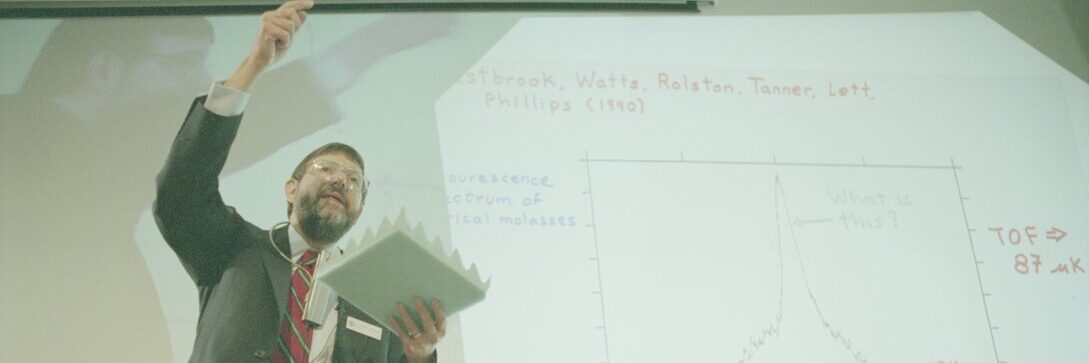
The phone rang at 3 a.m. William Phillips was at a scientific meeting in California, and the caller had a Swedish accent. He was told he’d won the Nobel Prize in physics. Then Swedish colleagues he knew personally came on the line, which Phillips figures was meant to convince him it wasn’t a prank.
That was 1997. He shared the prize with two colleagues for laser cooling, work he did as a federal employee at the National Institute of Standards and Technology (NIST). He spent 48 years there. On the newest episode of The Good Government Show, he tells Dave Martin why he never left.
Slowing atoms to keep better time
NIST exists to make measurements everyone can trust. That’s what lets countries trade with each other, and it’s why the time stamped on a stock trade means the same thing to everyone. Phillips wanted better atomic clocks, but the cesium atoms inside them move at more than 100 meters per second, which makes them hard to measure. So he and his colleagues used lasers to slow them down. It took roughly 1978 to 1990.
The payoff keeps growing. The Naval Observatory now runs clocks built on those techniques, designed and operated by former postdocs from Phillips’ lab. And laser-cooled atoms have become a leading platform for quantum computers, something he says nobody imagined when the research began.
Seed corn
Phillips argues that fundamental research is the part of the budget that’s easiest to cut, because it doesn’t pay off right away. His analogy is a farmer in a hard winter. Run low on food, and you’re tempted to eat the grain you were saving to plant. Cutting basic research, he says, is like eating your seed corn.
Why he stayed
He could have tripled his salary in the private sector. (His wife, he says, brings that up from time to time.) He stayed because he felt he was serving his country, and because he got to work alongside people smarter than he is. He also pushes back on the idea that federal employees watch the clock. The people he knows, he says, forget to go home for dinner.
What is good government?
Phillips answers with a Bible story and admits he doesn’t have a tidy definition, since nothing is entirely good. What he does believe in is the civil service, which replaced the 19th-century spoils system. Running something as big as a government, he says, takes institutional memory.
What you can do
His advice for anyone who wants government to work better is to write to your own congressperson. A letter you composed yourself, he says, carries more weight than a form petition. A letter with a stamp on it carries more still, at least from what he’s been told.
Phillips is being honored this month with a lifetime achievement award for outstanding federal service. It’s named in part for Katharine Gebbie, his late laboratory director at NIST. It’s a good time to hear from someone who spent a career doing the work, and enjoyed it.
Listen to the full conversation with William Phillips on The Good Government Show.